AIDE MEMOIRE: 
Scholarly Publishing Conference 2021

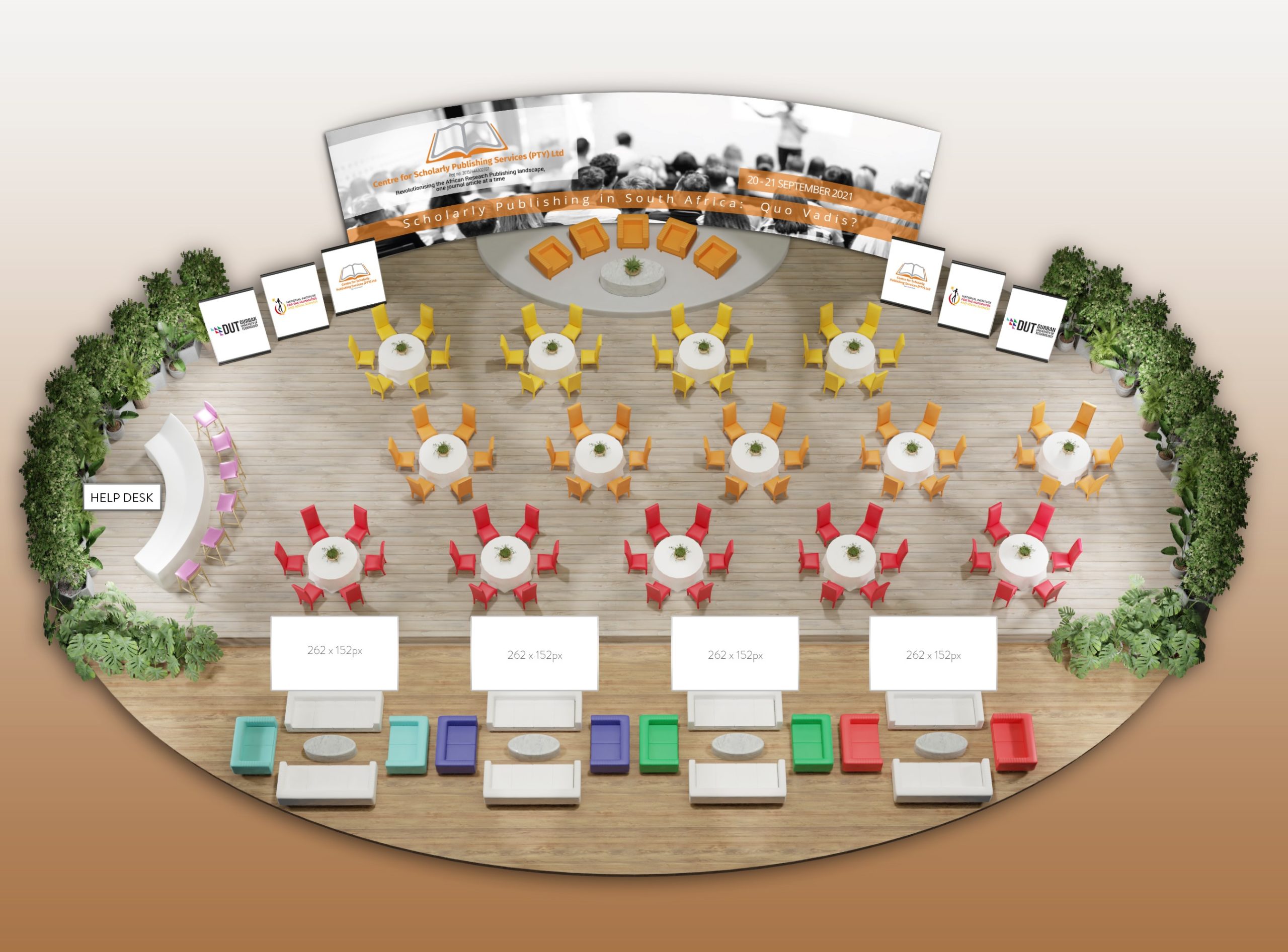
We look forward to welcoming you to the Scholarly Publishing Conference which will be held on Remo, from the safety of your home or office, for the dates 20 & 21 September 2021.

When
Monday, 20 September – Tuesday, 21 September 2021
Please see detailed programme attached.

Please ensure you log in at least 15 minutes before the start of a session in order to ensure you have gained access and your camera and microphone is working.


Where
live.remo.co/e/scholarly-publishing-conference-

Download
Remo is web based and best accessed via Google Chrome. Please ensure you are on the latest version of Chrome. You can download it here: www.google.com/chrome/

Interacting in Remo
live.remo.co/e/scholarly-publishing-conference-

Remo is a combination of “face to face” conversation (table mode) and view only “stage” {presentation mode).

When in table mode, you can turn on your camera and mic and interact with the other 5 people at your table. You can also do this via the table chat box function. You are not restricted to the table you are placed at when you arrive, you can jump from table to table by double clicking on an empty chair.

When in presentation mode, access to your camera and mic are disabled and you will be able to view the speaker and presentation on stage. You will still be able to interact via the table and general chat box function.

You can interact with the session chairs and presenters by raising your hand, typing in chat, or typing in the Q&A .

  1. Raise Your Hand
    Click the Raise Hand button at any time to indicate to the session chair and presenters that you have a question. (this is only accessable when in presentation mode)
  2. Should the session chairs be taking open questions, they will indicate to the technical team to give you access to your microphone. Once access has been given, accept the prompt and your mic will be open to ask your question.

Send Messages with Chat
There are 3 different chat function. General chat, table chat and private chat.

  1. Click the Chat button to open the chat panel.
  2. Type your message in the Text box at the bottom of the panel.
  3. Press the arrow to the right to send your message.

Ask questions with Q&A
You can ask a question annonymously or with your name. Any question can be upvoted in order for the session chair to know which question the attendees have more interest in. .

  1. Click the Q&A button to open the window. (this is only accessable when in presentation mode)
  2. Type your question in the text field.
  3. If you want your question to be anonymous, check the Send Anonymously checkbox.
  4. Click Send.

Your profile

To increase networking between attendees, please complete all your details in your profile by clicking on your profile picture on the top right of the page and update there.

To enhance your experience, the platform will be open the whole day on Sunday, 19 September 2021 for you to log in, update your profile and to familiarise yourself with the platform. Remember to paste the link in your Google Chrome Browser when doing so. Please ensure no other application is using your microphone or camera by ensuring that MS Teams and/ or Zoom app is closed when logging on.

Should you have any queries, or need any assistance, please do not hesitate to contact us on info@scholarlypublishingconference.co.za

Sincerely
Scholarly Publishing Conference 2021 Conference Committee
https://www.scholarlypublishingconference.co.za/

shadow

The impact of DHET subsidies on the state of scholarly publishing

What is the state of scholarly publishing in South Africa in light of the journal publishing requirements of many universities prior to the conferring of a Doctoral or a Master’s degree? Previous research statistics illustrated that higher education institutions produced an inordinate amount of journal articles as opposed to scholarly books and book chapters. What are the repercussions of the recent university policies on the publication of journal articles as prerequisites for graduation? What is the impact of the new policy on the subsidy for books and book chapters?

The role of research management in enabling and fostering scholarly publishing

What are the linkages between research management in South African universities and their contributions to scholarly publishing? Are research management offices fuelling the cult of subsidy generation over the production of quality outputs?

The state of peer review in scholarly journal publishing

What are some of the constraints faced by journal publishers and editors as far as the peer review process is concerned? Do we have enough peer reviewers for the amount of articles generated and submitted? What are journal editors’ experiences? What are researchers’ experiences of turn-around times as far as the publishing of journal articles is concerned?

The impact factors in journal publishing

Who decides whether a journal has a high impact factor or not? Why are certain journals, especially from the North, deemed as high impact factor journals long before even anyone publishes in them and why are most journals from the South, necessarily seen as low impact journals? What does this mean for the credibility of the science since these are determinants in the awarding of research grants, scholarly rankings and promotions?

The contribution of post-graduate studies on the emergence of a new cohort of researchers and their contribution to scholarly publishing

Are post-graduate students making headway in scholarly publishing? With the expectation that post-graduate students should publish prior to their graduation, what are some of the salient challenges that they face in this regard? Should supervisors be taking credit for their students’ work as co-authors? What are the ethics around co-authorship and what procedures are in place to ascertain whether post-graduate students are being adequately mentored in as far as research publishing is concerned?

The interface between ideas, money and the proliferation of predatory journals

The pressure to publish, as encapsulated in the motif ‘publish or perish’ has a harmful impact on the quality and efficacy of scholarly journals. It is argued in some quarters that the incentives offered by the DHET for the publishing of journal articles have unleashed a nefarious industry of predatory journals as well as unscrupulous practices by many academics, wherein the quality of what is published is superseded by the quantities involved. It is further argued that this has created an environment where profit has become so pervasive that rejections are viewed negatively due to their direct impact on the livelihoods of some.

What do university ranking systems mean?

In the recent past, there has been a proliferation of the publication of university rankings. Lo and behold, South African universities are publishing their rankings in various indices and the question remains, to what end? Is this meant to attract students and faculty? Or funding? Who determines the ranking, based on what criteria? What purpose do these rankings serve and what impact do they have on the scholarly outputs from such universities?

Is the university library still the mainstay of scholarly communication?

University libraries have for many years been the mainstay of scholarly publishing as they have been the leading purchasers of scholarly books. However, with the ever increasing costs of subscriptions to scholarly journals, it is argued that the university library is being squeezed as far as the purchasing of scholarly books is concerned. Moreover, with the advent of open access publishing and the fact that researchers can access journals virtually from anywhere in the world, what does the future portend for the university library?

Decolonising scholarly publishing

The South African university has been in a state of a ‘nervous condition’ since the advent of the #FeesMustFall movement. Since then, calls for the decolonisation of the curriculum have abounded. Surprisingly, however, there has not been a concomitant call for the decolonisation of the knowledge production industry. Therefore, a pertinent question arises as to how can scholarly publishing be decolonised? Who is getting published? By whom? What are their ideological inclinations? Are scholarly publishers innocent interlocutors in scholarly communications?

Disruptive innovation and the future of scholarly publishing

With the advent of a plethora of innovative and disruptive technologies in the scholarly publishing milieu, what does the future hold for scholarly publishing and communication? Whither the scholarly monograph? How will the bookselling value chain fare in the age of electronic distribution?

Reading, writing and publishing in African languages

If we are to decolonise the African university in general and the South African university in particular, why then are we not reading, writing and publishing in African languages? Why is the struggle for the decolonisation of the universities being waged using the language of the coloniser? Why are discourses on decolonising the university as well as the curriculum actually propounded in the language of the coloniser? What are the prospects of ever publishing scholarship in African languages? If there are impediments, how could these be practically overcome?

A special book volume will be published from selected peer reviewed papers by an internationally acclaimed publisher. The final full papers should not exceed 8000 words including notes and references.

Another batch of selected peer reviewed papers will be proposed for a special issue of a DHET accredited journal.

Monday 20 September 2021
Plenary Session Speakers

Chair: Prof Fulufhelo Netswera, Executive Dean, Durban University of Technology

Prof Sarah Mosoetsa, Chief Executive Officer, National Institute for the Humanities and Social Sciences

Prof. Sarah Mosoetsa is an Associate Professor of Sociology, at the University of the Witwatersrand, Johannesburg. She has previously worked as a senior researcher at the Human Sciences Research Council and the Development Bank of Southern Africa. Sarah completed her PhD in 2005 at the University of the Witwatersrand in the Department of Sociology. She has published in both local and international journals including Labour, Capital and Society, Transformation, and Journal of Southern African Studies. She has recently published a book entitled Eating from one Pot: Dynamics of Survival in poor South African households, Wits University Press.

Prof Pearl Sithole, Campus Vice Principal, Academic and Research, University of the Free State

Professor Mpilo Pearl Sithole is a social anthropologist by training, and has interest on issues of: governance; gender and development; the politics of knowledge production; and social inequality. She has worked with various academic and research institutions in South Africa; and she has delved into public service, consulting, and civil society as well. Her writings include a book titled Unequal Peers: The Politics of Discourse Management in the Social Sciences (2009), and a number of journal articles on governance, development, and knowledge production – including recently, the impact of the Covid-19 pandemic on developmentalism. In 2011 she was recognised by the South African Department of Science and Technology with a Women in Science Award – for her sterling work as a social scientist. More recently in 2021, she was appointed by Pope Francis into the Pontifical Academy of the Social Sciences. Vice-Principal: Academic and Research, University of the Free State, Qwaqwa Campus


Tuesday 21 September 2021
Plenary Session Speakers

Chair: Prof Fulufhelo Netswera, Executive Dean, Durban University of Technology

Prof Pumela Msweli, CEO, UNISA School of Business Leadership

Prof Pumela Msweli is the Executive Dean and CEO of the School of Business Leadership at UNISA.  Driven and entrepreneurial, Msweli has more than 24 years’ academic experience gained from South Africa, Canada, UK, Germany, Uganda, Mauritius, and Namibia. In her career as a social scientist, academic and researcher she has written and published locally and internationally in the area of global business, governance and development finance. Msweli has supervised fifteen doctoral students and over 35 masters students to completion.  Her distinguished scholarship, fundraising skills and acute multicultural sensibilities, enabled her to build fruitful partnerships with institutions all over the world.

Mr Mahlubi Mabizela, Chief Director: Higher Education Policy and Research, Department of Higher Education and Training

Mahlubi Mabizela is a Chief Director: University Policy and Development Support in the Department of Higher Education and Training (DHET). The Chief Directorate is responsible for the development and implementation of various policies in higher education; management and reporting on higher education research outputs; and the administration of the registration of private higher education institutions. The Chief Directorate is also responsible for supporting the work on transformation in higher education and the Higher Education and Training HIV and AIDS (HEAIDS) Programme, which renders health and wellness services to the higher education sector. Within the Department, he has for eight years led the work on institutional support and sector liaison which included governance support to universities councils and students’ representative councils. He has served in several advisory panels and boards, representing the DHET. He is the author of several peer-reviewed publications on Higher Education in South Africa and was the principal co-editor of a special issue of the Journal of Higher Education in Africa.